

Admiral Jayanath Colombage Participated in A Workshop on Maritime Domain Awareness in India
Time: 2026-10-02 Author: RCAS
Admiral Jayanath Colombage, Non-resident Senior Fellow of Hong Kong Research Center for Asian Studies, Participated in a regional experts' workshop, "Maritime Domain Awareness in the Indo-Pacific: National Approaches, Regional Gaps, and Opportunities for Collaboration", which was organized by the Council for Strategic and Defense Research (CSDR), New Delhi, in partnership with the National Institute of Advanced Studies (NIAS), Bengaluru.
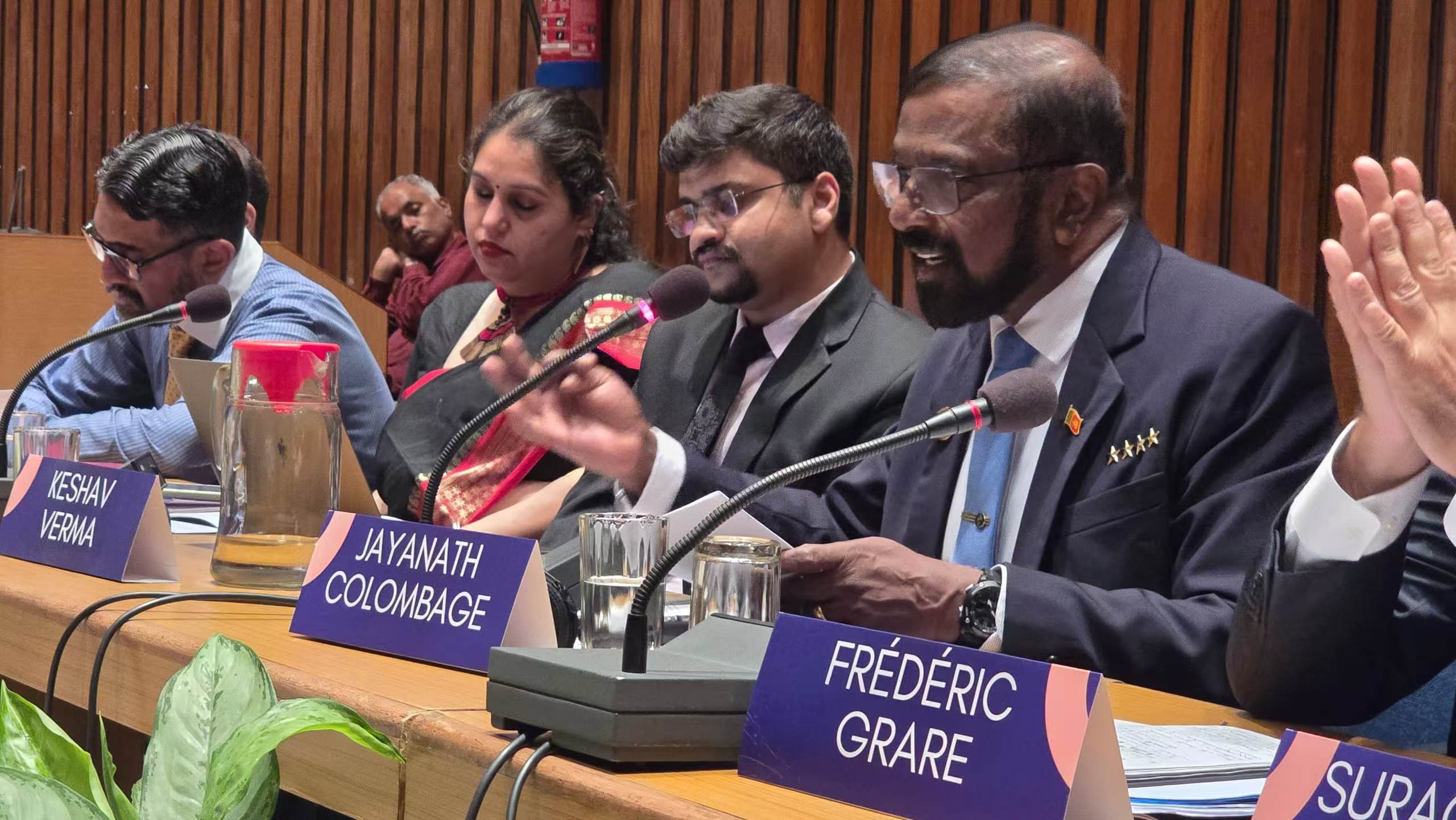
It was supported by the Asia Pacific Foundation of Canada as part of its Indo-Pacific research initiative with CSDR. The workshop was held on the NIAS campus on September 29th and 30th, 2026.
Maritime Domain Awareness (MDA) has become one of the central threads of Indo-Pacific security cooperation, yet national approaches remain fragmented. Countries define MDA differently, prioritise different threats, and operate largely separate information-sharing architectures.
This workshop brought together around 30 participants, including experts from across South Asia, Southeast Asia and the wider Indo-Pacific including USA, France, Canada, members of India's strategic community and maritime information-sharing ecosystem, and representatives of the commercial earth-observation sector concentrated in Bengaluru.
The aim was to map how countries actually approach MDA, identify where the gaps lie, and find concrete opportunities for collaboration.
Admiral presented a paper titled “National Approaches to Maritime Domain Awareness”. He described MDA as the effective understanding of anything associated with the maritime domain that could impact; Security, Safety, Economy, Marine environment. He highlighted three key components to MDA; Maritime Situational Awareness- based on the gathering of static and dynamic data to generate a picture of the current situation within the maritime domain, Maritime Threat Awareness-which requires the identification of the potential threat vectors that could be active within the area of interest, Maritime Response Awareness-covers the mapping and real-time tracking of available response resources to ensure that they can rapidly be deployed to counter threats.
Admiral compared maritime security challenges in the Indian- Pacific as: Major power competition-strategic competition, convergence, ambiguity and dilemma across the Indian Ocean Region (IOR), large number of maritime strategies of all these players- mostly Exclusive in nature not to the benefit of the IOR littorals but to achieve their strategic objectives.
He stated that this competition impact economic and Infrastructure development and have resulted in fractured maritime security architectures, presence of large number of non-state actors who can negatively influence maritime security and as we witness today the choke point vulnerability -closure of Strait of Hormuz and situation in Bab-el-Mandeb has resulted in higher energy prices, shortages of fertilizer and food security, increased cost of living and Increased shipping vulnerability, restrictions on freedom of navigation and ocean trade, and entrapment of mariners in a highly dangerous and volatile area-longer deployments and uncertainty and they are being subjected to attacks by missiles, drones, sea mines and speed boats.
Admiral stated that it was Sri Lanka started the MDA concept but called it as Combined Operations Picture (COP) since year 2000 as a result of Sri Lanka Navy (SLN) realizing that in order to fight the sea tigers effectively and to prevent them from attacking SLN units at sea and Harbours, SLN needed a complete real-time tactical picture around its coast of 1400 kms. In 2002 SLN developed an island-wide electronic surveillance network using a microwave backbone link.
All the coastal radars, day and night cameras with thermal imaging, Automatic Identification System, and communication networks were linked to the microwave backbone. This development of COP was one of the main contributing factors to defeat the Sea Tigers at sea and restrict their operations.
India adopted similar tactics after the 2008 Mumbai attack. The COP also led to the development of MDA concept between India, Sri Lanka and Maldives in 2011. This MDA concept was revived and renamed the Colombo Security Conclave (CSC) in 2020, and has since expanded. The attack on Iranian warship Dena by a US submarine was a wake-up call for the CSC-MDA.
Admiral Colombage emphasized the capacity constraints for successful CSC-MDA as: financial Limitations and Resource constraints, limited Institutional Capacity and limited implementation capability, Lack of Satellite and real-time data, lack of coordination and linkage between Information Fusion Centres (IFC), mistrust and lack of confidence building measures, and competing priorities, duplication of programmes, duplication of efforts.