
Admiral Prof Jayanath Colombage Participated in Roundtable Dialogue on South China Sea Security
Time: 2026-07-16 Author: RCAS
Admiral prof. Jayanath Colombage, a Non-resident Senior Fellow of Hong Kong Research Center for Asian Studies, participated in a Round Table Dialogue on South China Sea Arbitration organized jointly by Huayang center for Maritime Cooperation and Ocean Governance based in Haikou, China and Asian Academy of International Law in Hong Kong. The event was held in Hongkong Special Administrative Region on 13 July 2026.
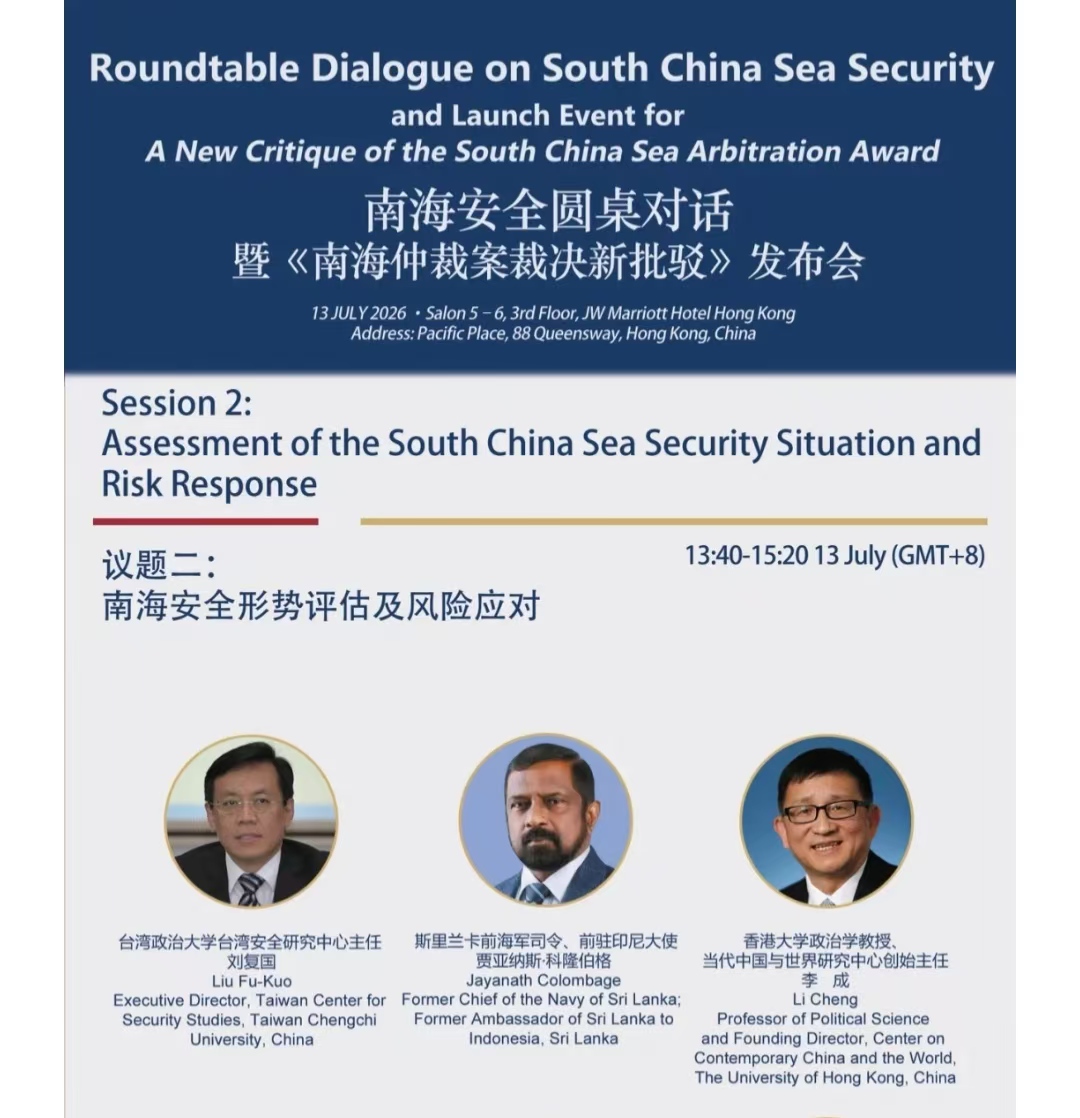
▲ Roundtable Dialogue on South China Sea Security
This conference coincided with ten years after ruling given on South China Sea Arbitration and brought together leading legal experts, maritime security practitioners and scholars representing universities and various institutions from China, ASEAN, South Asia, Australia, Canada, Germany, South Korea, USA, UK and Germany to asses the current and future trends in regional maritime situation and to explore practical approaches to crisis management and stability.
Admiral Colombage participated in the panel on ‘regional maritime security and risk response’ and presented a paper titled “Promoting Maritime Security, Regional Cooperation and Sustaining Peace and Stability in the South China Sea”. He highlighted the impact on maritime security and freedom of ocean trade especially for transport of energy across the Indian Ocean due to conflict situation in the Persian Gulf and Arabian Sea in the Indian Ocean and the negative impact this situation has resulted for many Indian Ocean littorals and the wider world.
Admiral further stated that South China sea serves as a vital route for international trade, supports abundant marine resources, and plays a significant role in the economic development and security of countries across the Asia-Pacific. Maintaining peace, stability, and cooperation in the South China Sea is therefore in the common interest of all regional states and the broader international community. The world cannot afford to have another insecure area in the South China sea as it would mean the collapse of world economic order leading to billions of people suffering immensely.
Admiral emphasized the importance of dialogue and consultation and direct communication between the parties concerned can help clarify misunderstandings, build confidence, and identify areas of common interest. He cited examples from the Indian Ocean how maritime boundary disputes have been resolved either by diplomatic means of by arbitration such as resolving maritime boundary between India and Sri Lanka in 1974 through bilateral negotiations in accordance with the International Law.
Admiral concluded by stating that building a shared maritime future requires all parties to exercise restraint, respect each other's legitimate concerns, and avoid actions that may escalate tensions. It also requires a commitment to resolving differences through peaceful means and in accordance with mutually agreed principles. By strengthening dialogue mechanisms, deepening practical cooperation, and enhancing confidence-building measures, they can create conditions conducive to long-term stability.