Why India Remains Russia's Most Reliable Strategic Partner
Time: 2025-12-18 Author: Sujit Kumar Datta
The visit by Vladimir Putin to India was not defined by the transactions that were reached, but rather the symbolism that ensued after the visit. The government actually received him with open arms. Prime Minister Narendra Modi received Putin at the Delhi airport, offered him a special dinner, and, after that, Putin accompanied President Droupadi Murmu in a state banquet in his honour. This is the kind of treatment that is accorded to a few leaders in the world, and more so in New Delhi. Modi even called the India-Russia relationship a pole star, a reliable and constant one.
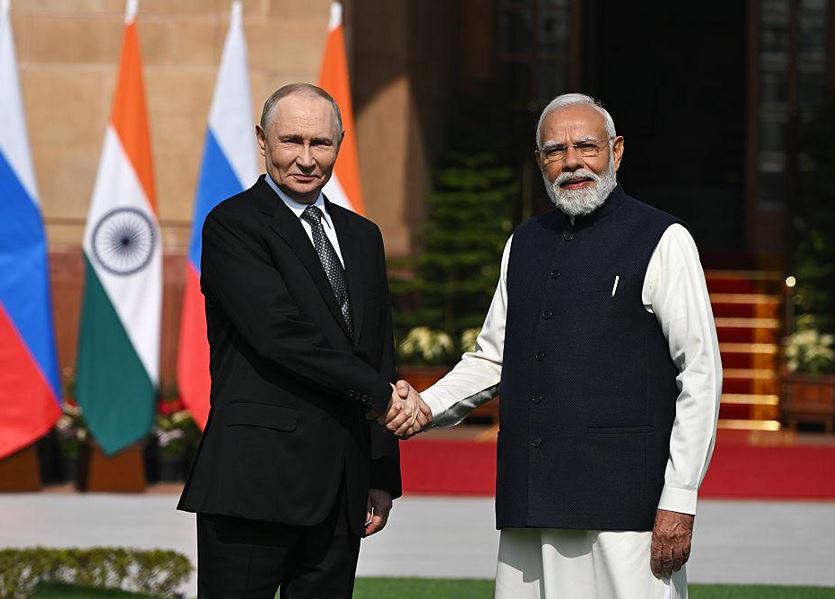
▲Photo: Collected.
However, even in the luxurious look, the contents of the summit were more prudent and moderate. It was in striking contrast to weeks of conjecture in the Indian media about big defence deals, be it fighter aircraft, drones, missiles, or air-defence systems. The protracted discussion between the Defence Minister Rajnath Singh and his Russian counterpart ended without any promise that showed the India-Russia defence cooperation, which was viewed as the cornerstone in the relationship in the past, did not evolve in any significant way. Instead, more emphasis on long-term economic interaction rather than short-term defence acquisition was put by the two locations during the visit.
This transformation signifies an increased amount of strategic realignment. Dependence on Russian military equipment has gradually declined over the past decade, but the operational predicaments of the old Russian systems have been on the rise. The war in Ukraine has also hampered Russia in terms of keeping to the timetable of supplies, providing advanced technology, or complying with previously reached-out-contract agreements. Against this backdrop, the recent India-Russia Economic Cooperation Roadmap 2030, which was published during the visit of Modi to Moscow earlier this year, has become the new point of reference against which the partnership is being restructured. Putin’s visit was the opportunity to assist in that change.
The most significant effect of the visit was the signing of the long-awaited Labour Mobility Agreement. By the end of the decade, Russia is expected to experience a shortage of about 3 million employees due to the decline in population and discontinuities in labour due to wars. In the instance of India, which has a surplus of skilled labour in sectors such as construction, engineering, metallurgy, shipbuilding, and healthcare, the agreement opens a new frontier of economic cooperation. Laid properly, this would be like the successful Indian labour mobility agreements with West Asia-with a great Eurasian power.
The summit also reached an agreement on maritime cooperation, port connectivity, and customs cooperation. They are technically what they purport to be, but a very important stratagem. They are expected to accelerate the implementation of two of the large connectivity projects: the Chennai-Vladivostok Maritime Corridor (CVMC) and the International North-South Transport Corridor (INSTC). These corridors would transform the flow of trade across India, Russia, Central Asia, and the Arctic region when operational, since a significant amount of time would be saved in terms of shipment and freight. The ability to split trade routes and reduce reliance on the chokepoints controlled by the West is seen as a key strategic need in both countries in the multipolar world order.
It was interesting, however, that there were no announcements especially in the oil procurement, space cooperation, and nuclear energy collaboration. Russian crude oil, which skyrocketed after the Western sanctions in 2022, has already become the centre of bilateral trade, and neither of the parties could offer assurance regarding the long-term pricing models and supply assurances. Similarly, the space industry projects that had taken longer before completion, like the joint moon missions, were untouched. Nuclear cooperation, which has been among the aspects of India-Russia relations, has not seen any advancement other than the routine technical discussions. This mismatch of symbolism and outputs has contributed to maintaining the impression that the summit was not rich in its deliverables.
However, it will be a mistake to assume that the visit was a boring exercise. Even in the case of India, there are still a number of strategic reasons associated with further relations with Russia. New Delhi appreciates the fact that Russia remains a significant player in Eurasia, which contributes significantly to the world energy markets, and is a dominant player in supplying discounted crude that has helped India to survive the turbulent times. The Russians also provide India with some strategic cushion on the international platform, such as the UN Security Council, where Russia has stood in a consistent position to support India’s positions. India needs to keep Russia on a good footing in order to afford some degree of flexibility in an ever-polarised world order.
However, India feels that the conflict in Ukraine and its’ de-escalation will allow India to take the geopolitical pressure it is currently experiencing off its hands. The war has forced New Delhi to walk a fine line in trying to maintain the long-time defence ties with Moscow, as well as the expansion of its strategic and economic ties with the United States and Europe. The longer the conflict lasts, the more irritated India is between these conflicting relationships.
Meanwhile, India is growing worried about the fact that Russia is getting more dependent on China. This has made Beijing the largest economic lifeline of Moscow since the outbreak of the war, since it has significantly reduced the strategic independence of Russia. This gives some concern to Moscow gravitating towards Beijing because India is the primary long-term opponent, whose main opponent is believed to be China. Improvement of India-Russia relations, even in other spheres of labour mobility and sea infrastructure, helps New Delhi to maintain a certain degree of leverage over Moscow and to ensure that Russia does not enter into the strategic orbit of China in its entirety.
Unlike the majority of Western powers, Russia does not have to make a choice in the Indo-Pacific on the side of India. New Delhi is making an additional investment in a bigger Eurasian policy that leaves the doors open on all fronts. The Russian concern over security in Central Asia, its new ties with the leaders of West Asia, including Iran and Saudi Arabia, and its growing role in the Arctic are all part of the wider Indian foreign policy aspirations. By not breaking its ties with Russia, India will continue to have access to a diversity of geopolitical theatres that are not under the dominion of Western institutions.
India remains to the Russians as the most reliable non-Western ally on account of a variety of reasons. India has refused to sanction in a Western fashion, augmented imports of energy, and proceeded to maintain a high degree of political contacts, and has been pressured to diminish relations. India was able to offer Moscow a ground of equality, confidence, and goodwill in the past, as compared to China, which usually bargains based on economic superiority. The diplomatic dance and the kind words of Putin were supposed to acknowledge this friendliness and convey a message that Russia still values the friendship of India.
Nonetheless, ultimately, the Putin-Modi conference showed that the Indian-Russian relationship is in a different phase that is not full of bombastic declarations but one of slow, slow reorganisation. The emphasis of defence relations can no longer be considered among the priorities of the partners, but the economic, demographic, and connectivity aspects are becoming more important. As the world’s geopolitics rapidly transforms, the two countries are continuing to establish a stronger and diversified relationship, which can survive external shocks.
This article was first published at Times of Bangladesh, Bangladesh, December 9, 2025,
https://tob.news/why-india-remains-russias-most-reliable-strategic-partner/.
