

The Gaza Truce: A Pause Button, Not A Permanent Solution
Time: 2025-11-29 Author: Sujit Kumar Datta
The information that the ceasefire between Israel and Hamas is not permanent and that the two years of endless and destructive warfare ended, constitutes a factor that the world is rightfully swamped with a sense of weary fatigue. The fact that a peace has been successfully temporarily established in the war in Gaza, which comes after a brutal campaign that costs tens of thousands of people, and virtually destroys the infrastructure in Gaza, is a moral victory of humanity. However, to call such a development a step towards peace would be disgustingly naive. This accord, the simple signature of which is still awaiting the final approval, a discussion of the 20 points in the Israeli Knesset, which is not a solution, a kind of pause button, pushed by a shattered Hamas, with the conditions of which it is set, is the solution to make the political subordination of the Palestinian people permanent. Hamas releases at least 20 living Israeli hostages on the 72-hour Plan. The deal will also result in the release of up to 2,000 Gaza inhabitants in the custody of Israel. However, the release will not come with a single deadline, already signaling the imbalance of power the document conveys.
▲Photo: Collected).
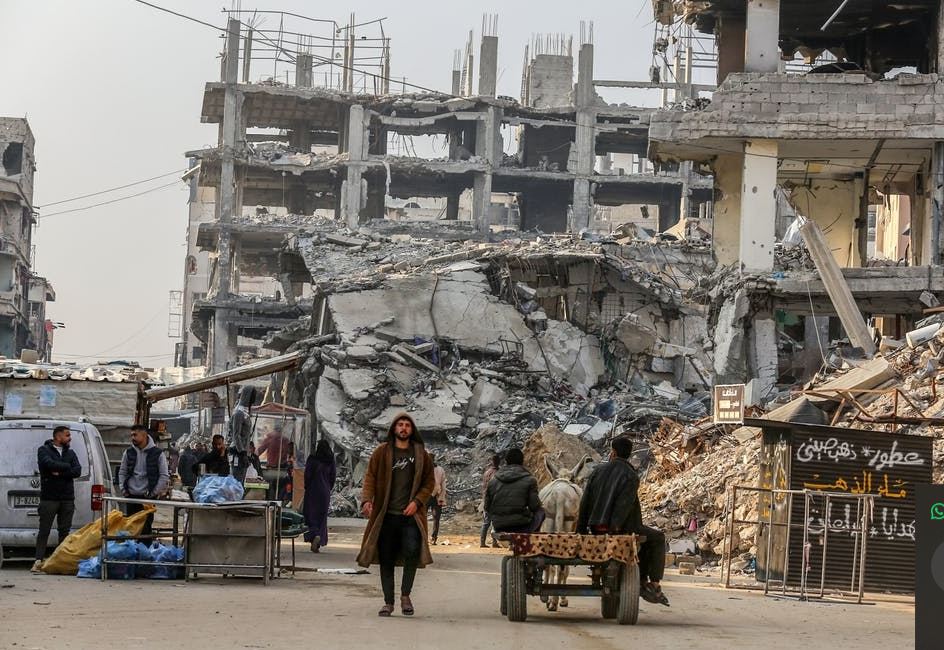
The offer of survival is more than any other consideration to the inhabitants of Gaza, who have already passed through an unimaginable apocalypse, in which, as far as can be calculated, 68,000 have been killed during the last two years. Even the assurance of life as such, should even this be inaccessible, is an unattainable distant luxury that is the ideal of freedom. The world’s plea is only: ‘Cease the slaughter.’ The 20-point Plan is a standard shell game that merely reacts to humanitarian demands, yet it constitutes a future geopolitical map of the takeover. The surface arguments can be applauded, as can the clean-up exercise, the opening of highways, the supply of aid, medicine, and the required products, and a promise to rebuild the infrastructure, all made through the Rafah border crossing. It is a minimum of what is needed to prevent immediate death in Gaza society.
The compromise is radical, not to rebuild houses but to demolish the Palestinian authority and to plant another government system that can not be defined as anything other than a neo-colonial government. The most outrageous ones are regarding the future discipline and security of the Strip. Gaza is ruled by a new technocratic administration that has been seen as neutral. Security will be controlled by an external organization, which will be suggested to be a peacekeeping operation, such as the UN’s. Suggested leaders of this new government are frighteningly sensational, a governing board consisting of Donald Trump, and a chief executive office consisting of Tony Blair. This very man has been quoted extensively and widely quoted as having been a mastermind in the disastrous Iraq War that took place in 2003.
The legacy that Tony Blair has left behind is inexplicably linked to the Western intervention and resultant confusion in the Middle East. The fact that the fate of Gaza is entrusted to the man who made the Iraq calamity could only demonstrate the insensitivity to the history and the expense of the region. It is a system of government that is the direct result of a project once considered the most insane. It is closely reminiscent of a wholesale evacuation of Gaza that was floated by the Trump circle in February 2023, and which implied the offering of the Strip inhabitants the possibility to leave the territory at a per capita price of 9000 dollars, and the transformation of the Strip into a pleasure center. Such unseemly words are not uttered by the current 20-point programme and its technocrats and rebuilding, but the end is the same: the irreversible political and territorial neutrality of Gaza.
The most unfortunate aspect of the 20-point deal may be its handling of Palestinian statehood, which is the source of the problems. The international peace concept, which has never been realized, is oddly absent from the Two-State Solution. Though the final line of the agreement is heretically feeble in offering any ray of hope, it states that after the above 19 points are put into practice, it might open the door to 19 points that could address a Palestinian state. This effectively shelters the dream of an independent state. Statehood is no longer an innate right or even a bargaining outcome; it is a reward; it is conditional, and it is conditional upon the accomplishment of a very long list of conditions implying the imposition of Gaza on the administration, the politics, and security of foreign forces – a purpose which may never be fulfilled. To Palestinians who have fought for decades to acquire autonomy of their country, it is a blow to the head; rather than having a picture of an independent state, they now have a picture of a protectorate that is internationalised, but is still occupied.
The ceasefire is therefore not an initiative to peace but a calculated withdrawal. Hamas wastes precious time in taking the truce and the seemingly impossible conditions. Time to stop the murder of its nationals, time to reorganise what remains of its political basis, time to reestablish its disorganised body forces, and time for its regional sponsors to regain. Along with it comes a sad choice: to resort to some immediate annihilation, or to a temporary political loss, with the slight hope of a reunion in the struggle sometime in the future. In the case of an existential threat, the most logical, but extremely unsatisfactory, option is survival.
The reaction of Palestinians is predictable. The Western media showcases the movies of celebration in Gaza City, the liberation of the families from the bombardment. Simultaneously, the Middle East sources also provide the reason behind the fear: the initial joy of survival is followed by the feeling of terror that this ceasefire will turn out to be the final suppression of their land by the Israelis and Americans. The simple, undeniable fact is that what the people of Gaza need at this point is life, particularly the traumatised ones who are fed up. It is the guarantee of survival, however wobbly and conditional it may be, that is the most significant victory that 68,000 of those lost lives are languishing amid the ruins in the streets.
This temporary truce of violence should not be mistaken for a peace foundation. Its structure is faulty and full of security loopholes, and it shows no serious commitment to statehood. It is a well-thought-out standoff button that allows the world to have a minute to take a sigh of relief and, at the same time, establish a new colonial reality in Gaza. It is an irony that the ceasefire, which is currently saving lives, may be taking away the dream of a free tomorrow. The path forward is the international community demanding, not just the hostages and aid being handed over, but with a strict deadline and a promise of an actual and full-fledged Palestinian state; otherwise, this procrastinating will only be preceded by more calculated and devastating political invasion.
This article was first published at Times of Bangladesh, Bangladesh, October.14, 2025,
https://tob.news/the-gaza-truce-a-pause-button-not-a-permanent-solution/.
